Showing posts with label obscurityknocks. Show all posts

Thursday, November 19, 2009

Obscurity Knocks: Six by Seven, "The Things We Make"

Welcome back to Obscurity Knocks, an intermittent series of posts highlighting my favorite unheralded albums. Coincidentally, these posts could also be titled British Bands I've Never Seen Live but Really Wish I Had. For this installation, we'll check in on the band Six by Seven, who qualify under both of the above guidelines.

Six by Seven, The Things We Make
Picture this: The curtains open on a group of chorus line of dreamers in 1970s leotards. It's 1996, and I, like so many other directionless liberal arts majors in the Bay Area, became a dot-commer, the effects of which continue to dominate my life. But among the run-of-the-mill rat race-type concerns, I enjoyed one surprising benefit: My Anglophilia rocketed off the charts. Thanks to the then-revolutionary technology known as streaming, the difference in time zones, and the fact that I was stuck at the computer for eight-plus hours each day, I had the perfect opportunity to tune into Steve Lamacq and the Evening Session on BBC Radio 1 every weekday. Not just any radio show, the Evening Session boasted access to exclusive tracks from and interviews with all the big names in British music, as well as a dedication to highlighting tons of up-and-coming bands.

Keep in mind that this was before the days of Napster, MySpace, BitTorrent, and the iPod, when only the chosen few were privy to leaked albums and you had to be an uber-geek to lay claim to a home broadband connection. (Note to self: You are old!) For me, at least, it was an invaluable advantage to be able to listen to music before paying exorbitant prices for the import single. And not just any old music, either--it was stuff I never heard and would likely never air on U.S. radio.

Granted, a lot of it was not very good; my CD collection is littered with discs that are not only unlistenable but unsellable. And the Evening Session wasn't immune to the bursting Britpop bubble; toward the late '90s, they spun horrible nu-metal bands--the very groups I wanted to escape. But for a few years, it was the radio show of my dreams.

I'm pretty sure I first heard Six by Seven on the Evening Session, very likely via "Candlelight." I remember thinking how much they sounded like the Charlatans (UK, I guess) on the single, which is kinda amusing, considering I'm not a Charlatans fan. There must've been something there, though, because I kept listening.

Somewhere along the way, I probably heard the singles "European Me" and "88-92-96," revealing roots more akin to the droney, shoegazer-based variety I love so much. Throw in a Flaming Lips (post-Zaireeka, but pre-The Soft Bulletin, thank you very much) remix of "Candlelight" and you get a pretty promising mix of influences and peers.

Perhaps a little history lesson is needed for those not steeped in the arcana of '90s-era British music. Though the band formed in 1991, Six by Seven didn't release their first single, "European Me," until 1997, followed by a couple more singles and a full-length album--the very subject of this post--in 1998. I don't particularly enjoy framing any artist in the context of another artist, but I'll say this about this record: It would've sounded conspicuously out of place in the Britpop landscape. In the wake, however, of 1997's landmark releases by Radiohead, the Verve, and Spiritualized, The Things We Make presents a logical progression.

Comparisons are cheap, and I admit they're a little tenuous in this case, so I'll try not to linger on the argument too much. What Six by Seven shares with Radiohead is a sonic boldness and a seeming dedication to art rock, and like the Verve, their music is imbued with palpable emotions. Of the aforementioned groups, Spiritualized may be their closest compatriot, albeit with fewer blatant drug references (on Six by Seven's part, that is). It's not hard to pick out the epic buzz and multilayered guitars, but I'll give the edge to Six by Seven in terms of passion.

I can't speak to the band's lyrics, and frankly, I can't recall many of them right now; if you're a word freak, this might be a pass. I also suspect listeners either love or hate singer Chris Ollney's voice, but it works for me, from the roar of "Something Wild" to the crooning "Oh! Dear" to the effects-drenched "European Me" and "88-92-96." As far as I'm concerned, it's really about the whole bundle--the voice, the guitars, the production, the pacing--and the mood that this album invokes. In a nutshell, it's a great package of pop and psychedelia.

Legend has it that "European Me" was heralded by the NME as "one of the greatest debut singles of all time" upon its release. Never mind that the NME makes that claim, on average, every other minute--the song is a great distillation of Six by Seven's trademark sound. The creeping tease, the deliberate pace, the intermittent squiggles of guitar, the seven-minute expanse--it sure sets the scene.

But for a pop girl like myself, "For You" may be my favorite track. There's no doubt that Six by Seven can carry off fractured, agonized dirges, but their power pop shines through on this tune, the closest to a hop, skip, and a jump that you'll find on the album. If I had my way, "For You" would play in the background of every sports highlight reel ever aired.

Rounding out the three faces of Six by Seven (for a total of 126?) is "Oh! Dear," a good, old-fashioned power ballad, or at least the late-'90s U.K. indie band version of one. If angst and abstraction dominate this album, "Oh! Dear" is the antidote, with the most straightforward lyrics of any song on this record. Don't worry, though; the fuzz pedal is still in effect, as is the single, elementary drum beat that characterizes many of the other songs on the record. Also, it clocks in at over seven minutes--but what's your hurry anyway?

I kept up with Six by Seven for a few more releases into the early 2000s, and for a time, my Two and Half Days in Love with You shirt never failed to spark conversation. As I recall, they didn't let up on the distortion on those follow-up recordings, but other impressions escape me. However, blame my attention span, not the band. As far as I'm concerned, they secured a permanent spot on my playlist with "The Things We Make."

Listen (right-click and choose Save Link As):
» Six by Seven: "European Me"
» Six by Seven: "For You"
» Six by Seven: "Oh! Dear"

See also:
» Obscurity Knocks: Marion, "The Program"
» Obscurity Knocks: Adorable, "Against Perfection"
» Obscurity Knocks: The Chameleons U.K., "Strange Times"
» Six by Seven on MySpace

Saturday, November 15, 2008

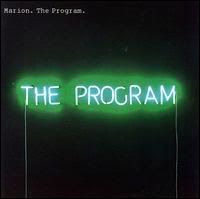
Obscurity Knocks: Marion, "The Program"

If you're reading this, it probably means I haven't gone to a gig in more than two weeks. Here, then, is the third in the Obscurity Knocks series, featuring my favorite neglected albums.

Marion, The Program
Marion, The ProgramAhh, the '90s--it may have started with shoegaze, but any Anglophile can tell you that it was louche, loutish Britpop that gave the world notice. (Those same Anglophiles are also likely to inform you that Britpop was only a brief movement in British music and not, in fact, the blanket term that pervades in the United States.) Granted, by the late '90s, it was clear that the Brits had drank too much of their own Kool-Aid or, um, other stuff, but for a sizable block of time, I wanted whatever they were having, though preferably blended and with a cherry--and while you're at it, could you stick an umbrella in there too?

Marion was not at the forefront of Britpop. They didn't date models--or, rather, models didn't date them. They didn't instigate and milk public feuds with other bands. They weren't regulars at the Groucho Club. They didn't save Glastonbury. In short, they were more indicative of the typical band vying for media attention, rather than the handful of tabloid regulars dominating the charts. I remember seeing the odd write-up on the band, but they mostly escaped my notice until Sharon turned me on to them. By then, it was 1999, a full year after The Program was released in the United Kingdom (though it never found an American label), and Marion's best days were behind them--not that we knew it at the time.

The Program would be their second and last album, and for this effort, they could lay claim to a noteworthy hook: fellow Mancunian--and need I mention legendary Smiths guitarist?--Johnny Marr as producer. I suspect his influence tempered the band's more jagged edges, but I'd like to think Marion's natural evolution and developing sophistication as musicians played a part too.

Whatever the case, the histrionics of their earlier releases are mostly absent on this record. Whereas every song on This World and Body, their debut record, started off in a jolt of guitar, the songs on The Program showed greater musical variety and maturity, incorporating layers of acoustic guitar, synthesizers, and harmonies.

Singer Jaime Harding's vocal style was always closer to the arch, patently British readings of Suede's Brett Anderson or Aladdin Sane-era Bowie than Oasis's populist pub rockers, for example, but on this album, he reins it in to the point that he's veritably cooing on "The Powder Room Plan" and the title track. Never fear, however; this isn't a Pat Boone record, and on songs such as "Miyako Hideaway," he shows off a newfound naturalism in his singing, while "All of These Days" retains the band's post-punk energy.

But when you have Johnny Marr at the helm, you know there's going to be some bad-ass guitar on the album. That's apparent from the lead-off track, "The Smile," which creeps in on a cloud of radio static, only to be cleaved apart by a snaking, confident burst of guitar, backed by a slow portent of a rhythm--something wicked this way comes. Guitarists Phil Cunningham and Tony Grantham do themselves proud on this album, supplying simultaneously forceful and melodic riffs, perhaps most effectively in "Miyako Hideaway" and "The Powder Room Plan." Elsewhere on the record, they craft the lovely "Sparkle" and the taut, moody "The Program" around the acoustic guitar--simply gorgeous.

To those who read the inaugural installation of Obscurity Knocks: I wasn't kidding about the Chameleons being one of my greatest musical touchstones. I admit I may hear the Chameleons where others don't, but I can't help it--it's part of my musical DNA at this point.

Anyway, the Marion/Chameleons crossover moment comes about two-thirds of way through the dreamy "What Are You Waiting For?" The instruments drift to the background, and the keyboards sound out the transition. It doesn't even last 10 seconds, but it instantly transports me to the introduction to "In Answer" from the Chameleons' Strange Times. I'm pretty sure that's when I fell in love with The Program. (I was so smitten, in fact, that I pushed it on two other close friends, both of whom embraced it as well.)

I never saw Marion live, but a couple of years following my introduction to the band, Sharon gave me a bootleg of their show at the Troubador in Los Angeles, circa 1998. Watching the video, it's impossible to overlook how exceedingly pale and painfully thin Jaime appeared, even for a British rock star. By the time I saw this tape, the band had already dissolved, and Jaime's drug use was a simple matter of fact, but the show confirmed some of the worst suspicions. To this day, I can't listen to the lyrics of "The Program" ("Ever get the feeling you're losing control?") without wondering about its autobiographical implications.

Apparently, the band has reformed, and they're writing new songs and playing gigs in England, though they've once again faced more obstacles (Jaime had open heart surgery?!). I'm not holding my breath, but I would love to see them for myself one of these days. In the meantime, I'll go back to enjoying all my favorite tracks from The Program.

Listen (right-click and choose Save Link As):
» Marion: "The Program"
» Marion: "The Smile"
» Marion: "What Are We Waiting For?"

See also:
» Obscurity Knocks: Adorable, "Against Perfection"
» Obscurity Knocks: The Chameleons U.K., "Strange Times"
» Marion on MySpace

Sunday, January 27, 2008

Obscurity Knocks: Adorable, "Against Perfection"

In my most dedicated years as an Anglophile, I remained untouched by many of the biggest U.S. musical trends. Were you listening to hair metal in the late '80s? I was stuck on Madchester's comings and goings. Grunge? It was all about shoegaze to me. Nu metal? Those were the golden years of Britpop, baby! Not that the stuff I listened to was necessarily better--for Pete's sake, I knew the words to songs by Ned's Atomic Dustbin! And I missed out on a lot of great hip-hop. Regardless, for this installment of Obscurity Knocks, I'm turning back the clock to 1993 to reminisce on Adorable, hailing from Coventry, England.

Adorable, Against PerfectionAdorable, Against Perfection
There's a reason I kicked off this series with the Chameleons: Their signature guitar sound would become the musical trope that I subconsciously followed for many years--until I finally made the connection and consciously sought out bands reminiscent of their sound. Adorable, for me, were one of the first bands to emerge after the Chameleons who exhibited this crucial feature, which is why they're the second band in this series.

Before the spread of the Internet and file sharing, I bought nearly every used copy of Against Perfection I came across--not because it was a collector's item or valuable by any monetary measures. Rather, I truly believed that I would be able to find it a good home, if not alongside multiple copies of the exact same CD on my own shelves, then with someone who would fall under its spell as soon as they heard the wonderful riffs on the record. Fortunately, I didn't stumble upon the disc that often because I could never really convince anyone to give this CD much of a listen.

Adorable came up during the shoegaze era, not quite 10 years after the Chameleons, during which the phrase "sonic cathedral" (or, if you prefer, "cathedral of sound") was popularized and, eventually, lapsed into cliche. Guitars were prominent--or, at least, more notable since the vocals were buried so deep--during this movement, and Adorable wasn't alone with a sound that could be traced back, in part, to the Chameleons and their contemporaries. In Adorable's case, that inspiration came from Echo and the Bunnymen.

I was a fan of many bands housed under this umbrella, but Adorable was the only group to incite such a Pavlovian response in me. Simply, they were one of the only ones who came close to anything approaching pop music. (Catherine Wheel is one of the others, but their preening performance in concert turned me off.) Sure, the others turned up their effects pedals and erected a wall of sound in which you could lose yourself, but Adorable had honest-to-god choruses and hooks to complement those massive musical constructs.

For better or worse, the vocals can make or break a band for me, and Piotr Fijalkowski's voice reeled me in. At times, he sounded steely and accusatory ("Favourite Fallen Idol"), other times melancholic and resigned ("Still Life"--and by the way, the guitar on that song has to be an ode to the Smiths' "Back to the Old House"), and on my favorite tunes, unabashedly exuberant ("Sunshine Smile" and "Glorious").

Singling out guitars and vocals has to be the music blogger's equivalent of shooting fish in a barrel, so I'll add that the bass lines (supplied by Piotr's brother Wil) may be the most underrated aspect of Against Perfection. In fact, I'm pretty sure those rubbery notes initially caught my ear when I heard Adorable's semi-hit "Homeboy" on American radio. The bass makes an impact on the mellower songs too, such as the aptly titled "Glorious."

I don't recall being particularly struck by the lyrics, but I know that a friend recently got married, and Adorable's "Breathless" figured in the ceremony. Also, I never got to see Adorable live, though I remembered they played my hometown of San Jose, Calif., in some free radio event--too bad I had moved away for college by then.

I didn't know much about the band when they were together, and it was long after they broke up that I found some interviews and learned that they were somewhat reviled among the U.K. music press for, ironically, their cockiness. This blackballing probably didn't help their case, but regardless, they lasted for only one more album, Fake. Piotr and Wil formed another band called Polak, in reference to their heritage; last I heard, Piotr had his own bookstore in Coventry. Update: A quick Google search says a solo career may be in the offing.

Apparently, we may soon see a shoegaze revival. My Bloody Valentine has reformed and is playing dates across the United Kingdom, though the usual suspects in the U.K. music press continue to bitch and moan about it. And if you've been in the clubs, you may have heard the sound echoed by newer bands. Wherever this resurgence may lead, I'm pretty sure Adorable won't be one of the groups caught in the upswing, but I strongly suspect I'll continue to listen to them for many more years to come.

Listen:
» Adorable: "Glorious"
» Adorable: "Homeboy"
» Adorable: "Sunshine Smile"

See also:
» Obscurity Knocks: The Chameleons U.K., "Strange Times"

Monday, July 09, 2007

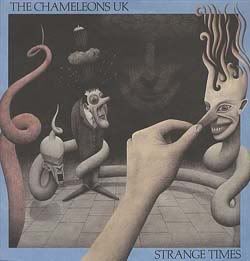
Obscurity Knocks: The Chameleons U.K., "Strange Times"

I don't read many music blogs or news sites, but I've been sucked in by Idolator, though not so much for the buying advice, the gossip, or the requisite snarkiness. Rather, the site's editors seem to have a broader view of the musical landscape, removed from crowning and/or tearing down the latest indie sensation.

One of my favorite semi-regular features on Idolator is the Coulda-Shoulda-Woulda Files, which celebrates releases that never gained traction with the general public, always a popular topic among dedicated music fans. Thus, I'm kicking off my version of every music lover's favorite game: If I Ruled the World. I'll probably cough up a few more iterations in this series whenever the concert schedule slows down.

The Chameleons U.K., Strange Times
The Chameleons U.K., Strange TimesTo everyone who's read this blog for the last two-plus years: thank you kindly. But I've been a little disingenuous, as my longstanding Anglophilia has been woefully underrepresented on easily fooled. I'm just not that excited about the current crop of bands from England, but who knows? It's not the first time I've sworn off the U.K. hype machine, only to be fully assimilated by some shambling outfit out of Manchester, England.

Which brings me right to the Chameleons (or the Chameleons U.K., as they were known in the United States), who were indeed a shambling outfit out of Manchester, England. You can read the bio on allmusic, but a short recap: Formed in the early '80s, the Chameleons were classic underdogs who faced their share of Behind the Music-style cliches--early critical acclaim, followed by record company fiascoes, then eventually unraveling under the weight of personal issues.

The Chameleons weren't unknown in the States; they had a couple of "modern rock" hits ("Tears" and "Swamp Thing") off Strange Times, and they toured here at least once--including a visit to One Step Beyond, a club in Santa Clara, California, I frequented as a teenager on its "youth nights" (bwahahahaha). Strange Times, backed by Geffen Records, was supposed to be their breakthrough in America, and they even got a write-up in the New York Times. Alas, it turned out to be their swan song, though numerous live albums and reissues came out later. I finally got to see them live in 2000 when they regrouped, but they broke up again the following year.

Though my cultural barometer is shot these days, I swear that neither the Smiths nor the Cure were popular in 1983 at Sylvandale Junior High--or in 1987 at Oak Grove High School, for that matter. But I can assure everyone that the Chameleons have never broken through to anything approaching the level of notoriety enjoyed by either former cult band. Case in point: A dear friend I've known 20+ years is also a major Chameleons fan, but for several years after meeting each other, we didn't realize we had this in common, though we talked about music all the time.

If you read this blog for my current musical preferences, this album is likely not for you. The production on Strange Times is straight up '80s--that is, the drums are huge, but oddly, they're slightly turned down from the Chameleons' earlier releases. And synth fills were used in the making of this album. But hey, if you can listen to U2's early releases, you should be able to give the Chameleons a chance.

If, then, you put the disc on for a spin, you'll hear the lead-off track "Mad Jack" and its opening thunderbolt of guitar. About 5 seconds into the second track "Caution," you might notice a tickle of fretwork, followed about 20 seconds later by shimmery, expansive chords that are so welcoming, they practically roll out the carpet for you. Dave Fielding was the man responsible for that sound, one of the two elements that sealed the Chameleons' standing in my book. At the time, all I knew was that he made it sound soooooo cool, simultaneously jagged and crystalline, nothing like the vapid, preening cock rock that has always ruled American radio. This was my idea of heaven; for many years afterward, nearly any band that came close to those acoustics went straight to the top of my list of new faves. But all in due time.

The Chameleons grabbed me on another front: Mark Burgess's impassioned lyrics and vocals. OK, that's two things, but they're kinda the same. Again, to unfamiliar ears, the lyrics, like the production, might seem over the top, but they were both a salve and a spark to my angst-ridden teenage soul. Certainly songs such as "Childhood," "I Remember," and "Time/The End of Time," fixated on the past, but the tunes that stayed with me addressed feelings of alienation and the struggle to remain an individual. For example, there's "Soul in Isolation," with its cry of "I'm alive in here" (and its ability, to this day, to make one of my best friends burst into tears); the sprawling, spiraling "Caution"; and a lyrical nod to Wordsworth in "Swamp Thing," which always struck me as an '80s-stamped bastard child of "Come Together."

If you ask any former New Waver about the Chameleons, odds are the only song they'll remember by the band is "Tears"--as well they should. This was the Chameleons' take on pop perfection: guileless but not cloying lyrics about loss; a sunny but forceful melody; a steady, emphatic beat; and lucid touches of guitar. "Tears," along with the unexpectedly tender "In Answer" ("you own my soul completely...you're all that matters to me"), showed a delicate side to this otherwise gruff Manchester crew.

Listen:
» The Chameleons: "Mad Jack"
» The Chameleons: "Caution"
» The Chameleons: "Tears (Original Version)"

See also:
» Star Hits: a tribute